Local GuidesRepair Tips
Slow Drains Throughout the House: What It Means
When every drain in your Bradenton home slows down at once, it is rarely five separate clogs. Here is what slow drains throughout the house actually mean.
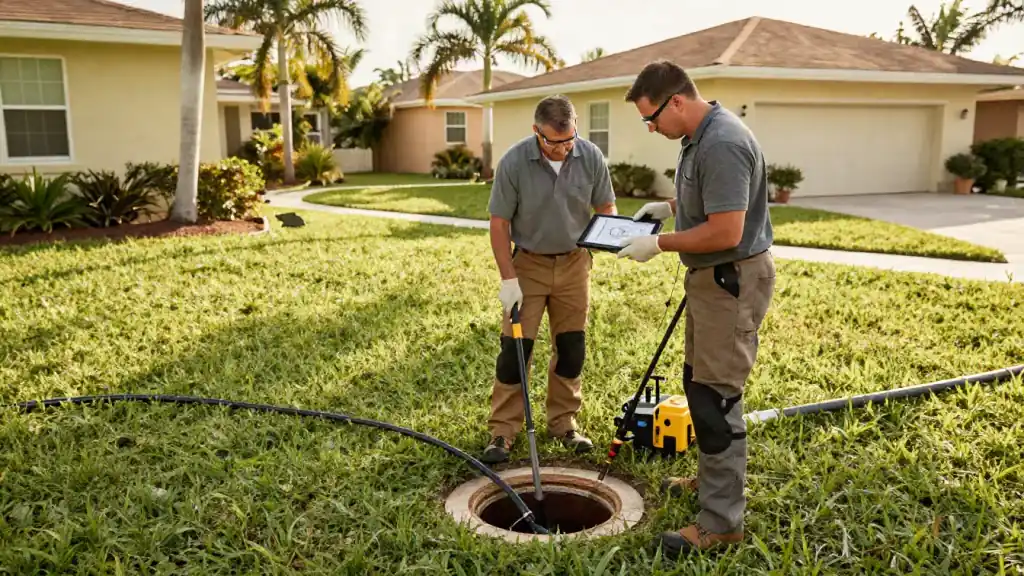
Slow drains throughout the house almost always mean one thing: the blockage is in your main sewer line, not in the individual fixtures. When a kitchen sink, a bathroom sink, a tub, and a toilet all drain sluggishly at the same time, the shared pipe those fixtures feed into is the problem - and no amount of plunging one sink will fix it. We run into this constantly in Bradenton, especially in homes built before 1990 where cast iron and Orangeburg pipe have had decades to scale up, shift, and collect roots. Below we break down what causes whole-house slow drains, how to tell a main line clog from a single-fixture clog, what fixes actually work, and when it is time to bring in a pro.
What Slow Drains Throughout the House Actually Mean
Slow drains throughout house meaning Bradenton FL homeowners search for is simple: the main drain line leaving your home is partially blocked, so wastewater from every fixture backs up behind the same obstruction. Your home's drain system is a tree, not a set of independent pipes. Each sink, tub, shower, and toilet connects to a branch line, and every branch line feeds into one main line that runs under the slab or through the yard to the city sewer or your septic tank. When that trunk is restricted, every branch drains slowly.
That is why a single slow sink is usually a local clog - hair, grease, soap scum - while multiple slow drains Bradenton households report across the whole house point to the trunk. The distinction matters because the fix is completely different. Clearing a P-trap takes ten minutes. Clearing a main line clog takes a drain auger, a camera, and often a hydro jetter.
One more thing worth knowing: slow drains are the early warning, not the emergency. A fully blocked main line sends sewage back up through the lowest drain in the house - usually a shower pan or a floor drain. If you catch the slowdown now, you avoid the backup later.
Why Are All My Drains Slow in Bradenton?
Bradenton's soil, water, and housing stock create a specific set of drain problems you do not see in newer cities. Three factors do most of the damage here.
1. Sandy soil and shifting ground. Much of Bradenton sits on sandy, loosely compacted soil. Over years, that soil moves, and buried drain lines move with it. A pipe that was pitched correctly at installation can develop a belly - a low spot where water pools and solids settle. Once a belly forms, the line clogs again and again no matter how many times you snake it.
2. Tree roots. Live oaks, magnolias, and palms are everywhere in Bradenton, and their roots seek moisture. A hairline crack or a loose joint in a clay or cast iron line is an open invitation. Roots enter as thin threads and grow into a mat that catches everything else you send down the drain.
3. Aging pipe materials. Homes in Downtown Bradenton and the older riverfront neighborhoods frequently still have cast iron drain lines installed in the 1950s through 1970s. Cast iron rusts from the inside out. After 40 or 50 years, the interior is rough as sandpaper, and every bit of grease and paper snags on it.
Add Bradenton's hard water - which leaves mineral scale inside pipes - and you have a system that narrows year by year. By the time all your drains feel slow, the line may be down to half its original diameter.
The Five Most Common Causes of Slow Drains Bradenton Homeowners Face
Causes of slow drains Bradenton homeowners deal with fall into five buckets, and they are not equally likely. Here is what we actually find when we camera a slow main line.
- Grease and food solids (most common in kitchen-fed lines). Cooking oil, bacon grease, and coffee grounds coat the pipe wall. Over months, that coating hardens and narrows the line.
- Tree root intrusion (most common in lines more than 20 feet from the house). Roots find joints first. By the time you notice slow drains, the root mass is often the size of a softball.
- Scale and corrosion buildup (most common in cast iron). Rust nodules and mineral scale can reduce a 4-inch line to a 2-inch opening.
- Pipe bellies and offset joints (most common after ground movement). Water pools, solids drop out, and the clog rebuilds in the same spot every few months.
- Flushable wipes and paper products (most common in homes with kids or guests). Even "flushable" wipes do not break down. They tangle with grease and roots and form a plug.
If your slow drains came on gradually over weeks, suspect grease or scale. If they went from fine to slow in a day or two, suspect a wipes plug or a root mass that finally closed the gap.
How to Tell a Main Line Clog From a Single Fixture Problem
A main line clog slow drains Bradenton homeowners describe has a signature you can test in about five minutes. Run the test below before you call anyone - it tells you whether you are dealing with one fixture or the whole system.
- Fill the kitchen sink and the bathroom sink with a few inches of water.
- Pull both stoppers at the same time.
- Watch how each drains, and listen.
If both drain slowly, the shared line is restricted. If only one is slow, you have a local clog in that branch or trap. Now flush a toilet while the tub faucet is running. If the tub gurgles, or water rises in the shower pan, the main line is the problem - full stop.
Another tell: smell. A main line that is partially blocked vents sewer gas back through the lowest fixtures. If your guest bathroom smells like a sewer even after cleaning, that is a main line issue, not a cleaning issue.
We confirm the diagnosis with a sewer camera inspection Bradenton before we quote any repair. A camera shows the exact depth, the material, and whether the obstruction is grease, roots, scale, or a collapsed section - which changes the fix entirely.
What to Watch Out For Before You Pour Anything Down the Drain
Chemical drain cleaners are the single most common mistake we see, and they make the eventual repair more expensive. Store-bought caustic cleaners generate heat - enough heat to soften PVC joints and crack already-weakened cast iron. They also sit in the pipe as a caustic slug that our technicians have to neutralize before we can work safely.
Other things to avoid:
- Do not run a hand snake through a main line cleanout and force it. You can push a root mass into a solid plug or punch through a corroded pipe wall.
- Do not keep flushing a slow toilet. Each flush adds 1.6 to 3.5 gallons to a line that is already backing up.
- Do not ignore a sewer smell. It usually means a dry trap or a blocked vent, and both point to a system problem.
- Do not assume one snaking fixed it. Snaking opens a hole through the clog. It does not clean the pipe wall, so the same clog returns in 60 to 90 days.
If you have already used a chemical cleaner, tell the technician before they start. It changes how we approach the line and how we protect the work area.
Slow Drains in House Solutions Bradenton Florida Homeowners Can Try First
Slow drains in house solutions Bradenton Florida homeowners can handle themselves are limited, but a few are worth trying before you call. Start with the least invasive option.
Boiling water. For a kitchen line with grease, a full kettle of boiling water poured slowly down the drain can melt a light grease film. Do this once, not repeatedly - and never on a PVC line that is already under a sink full of standing water.
Plunging correctly. A cup plunger works on sinks and tubs. Block the overflow opening with a wet rag first, or you will just push air. For a toilet, use a flange plunger and make sure the bowl is at least half full of water.
Cleaning the P-trap. If one sink is slow and the rest are fine, the trap under that sink is the likely culprit. Place a bucket underneath, unscrew the slip nuts by hand, and clean the trap with a bottle brush. This is a 15-minute job and it solves a surprising number of single-fixture clogs.
If the whole house is slow, none of these will help. That is a main line problem, and it needs a main line drain cleaning Bradenton FL service - not a bottle of chemicals. Depending on what the camera shows, we clear the line with a cable machine or a hydro jetter, then re-camera to confirm the pipe is clean wall to wall.
When to Call a Professional
Call a professional the moment two or more fixtures slow down at the same time, or the moment water backs up anywhere it should not. Those two signs mean the main line is restricted, and every flush you run after that adds pressure to a system that is already at its limit.
You should also call if:
- You have snaked the line yourself and it slowed again within a month.
- You hear gurgling in a tub or shower when the toilet flushes.
- Sewage odor lingers in the lowest bathroom.
- You see soggy patches in the yard above the sewer line.
- Your home is more than 30 years old and has never had a camera inspection.
At Bradenton Drain Cleaning, we handle the whole job: locate the blockage, camera the line, clear it, and verify flow before we pack up. We work across West Bradenton and the surrounding neighborhoods, and we quote the price before we start so you are never guessing. If the line needs more than cleaning - a root cut, a pipe repair, or a new cleanout - we tell you straight and show you the camera footage.
Frequently Asked Questions
What does it mean if all my drains are slow in Bradenton?
It means the main sewer line is partially blocked. When every fixture drains slowly at once, the shared trunk line is restricted - usually by grease, roots, or scale. A single slow fixture is a local clog; multiple slow fixtures is a main line issue that needs professional clearing.
Why are my house drains slow in Bradenton FL?
Bradenton's sandy soil, mature trees, and older cast iron pipe create the perfect conditions for main line buildup. Roots enter joints, ground movement creates bellies, and hard water leaves scale. Most slow-drain calls we run in Bradenton trace back to one of those three.
Can slow drains mean a main line clog in Bradenton?
Yes - and it usually does when more than one fixture is affected. Run the two-sink test: fill the kitchen and bathroom sinks, pull both stoppers, and watch. If both drain slowly, the main line is clogged. A camera inspection confirms it in minutes.
How to fix slow drains in Bradenton?
For a single slow sink, clean the P-trap and plunge. For whole-house slow drains, the fix is mechanical: cable the main line to open it, then hydro jet to clean the pipe wall. Most main line clogs clear in one to three hours, and we re-camera to confirm.
How much does main line drain cleaning cost in Bradenton?
Typical 2026 pricing in this area runs $250 to $600 for a standard main line clearing, and $400 to $900 when hydro jetting is required. Camera inspection is often included or added for $150 to $300. Root removal and pipe repair are quoted separately after we see the footage.
Get Help With Drain Cleaning in Bradenton
If every drain in your house is slow, you do not need five separate repairs - you need one main line cleared by someone who knows Bradenton's pipes. We diagnose with a camera, clear the line, and confirm the flow before we leave.
Call Bradenton Drain Cleaning at (941) 393-1128 and we will get your drains moving again, usually the same day.